
Walki and Dow collaborate on a groundbreaking mono-material MDO-PE packaging solution
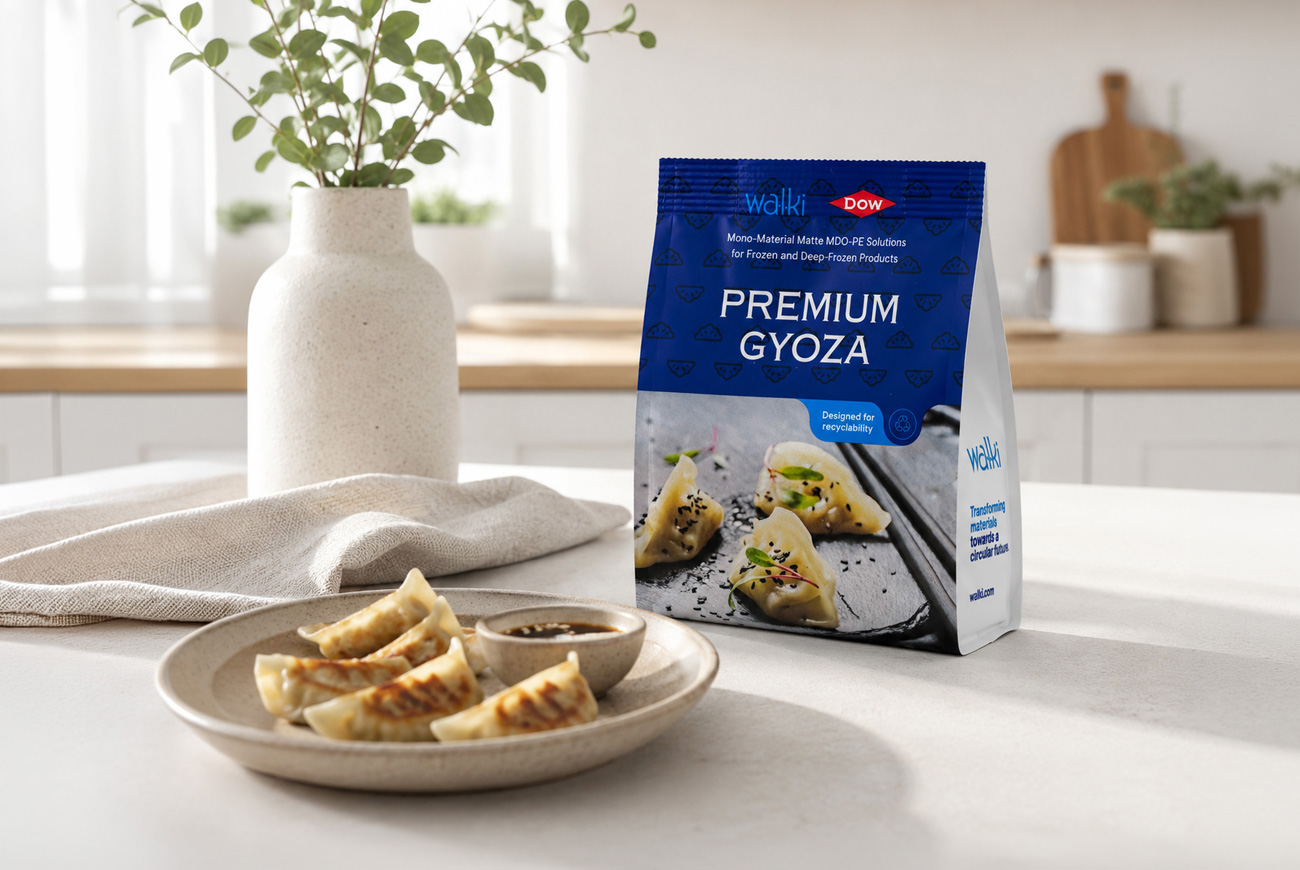
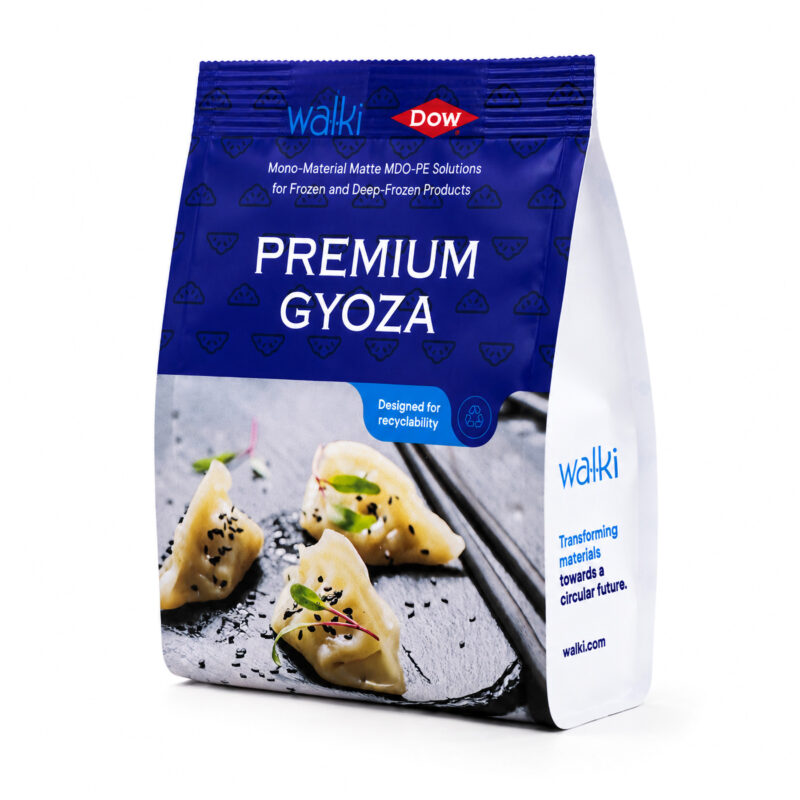
By combining expertise, the companies developed an innovative MDO-PE pouch with a premium matte finish, designed for recycling.
As the packaging industry undergoes one of its biggest transformations ever with the Packaging and Packaging Waste Regulation (PPWR), innovation and collaboration have never been more critical. Walki has a long-standing relationship with materials supplier Dow, built on years of shared R&D and close supplier partnership. Juan Angel Ruiz Salazar, R&D Manager at Walki Plasbel, and Ksenija Maksimovic, Senior TS&D Specialist at Dow Packaging & Specialty Plastics EMEA, have been jointly exploring new material concepts together for several years. Their latest collaboration resulted in a prototype of a mono-material MDO-PE laminate with a matte finish, designed specifically for frozen food pouches.
MDO stands for Machine Direction Orientation, a process in which polyethylene film is stretched in the direction of production to improve its mechanical properties. The result is a film with enhanced stiffness, barrier performance and clarity. These performance attributes enable MDO-PE to replace traditional print web films, like oriented polyester, and when combined with a PE-based sealant film, the resulting all-PE laminate is meeting design-for-recyclability guidelines.
Matte finish for a stronger shelf presence
MDO films typically deliver a highly glossy surface, one that many brand owners find incompatible with their brand identity. A matte finish is often preferred for premium products, conveying quality and a strong shelf presence that communicates the right brand attributes to consumers.
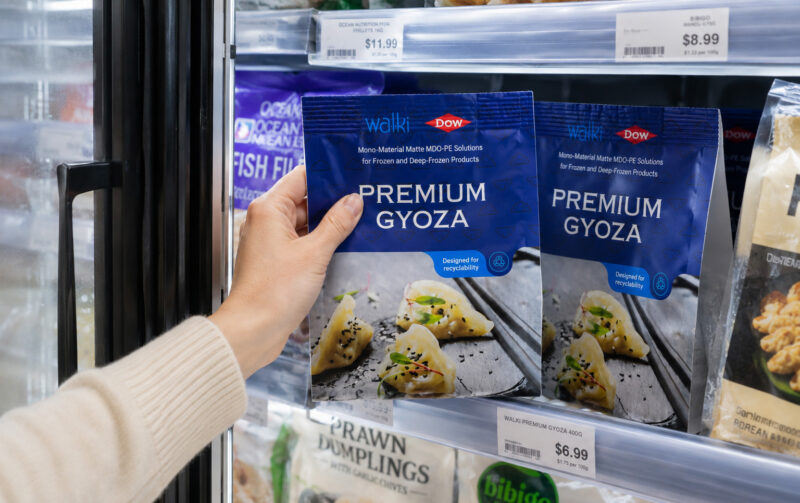
The development also reflects broader changes in consumer behaviour and retail presentation. Frozen and prepared foods are increasingly positioned as premium, high-quality meal solutions rather than purely convenience products. At the same time, supermarkets are moving from traditional open freezer cabinets to more transparent glass-door freezer systems, where packaging visibility plays a much greater role in attracting consumer attention.
In this environment, packaging design and surface appearance have become increasingly important for brand positioning. A premium matte finish combined with high-quality printability helps brands communicate quality, freshness and product differentiation directly at the point of sale.
“There has been a need for a solution that delivers the functional performance of MDO-PE but with a premium matte appearance”, explains Ruiz Salazar.
So when Maksimovic called him and told him that the Dow team had developed a matte finish and asked if Walki was interested in developing it further, Ruiz Salazar did not hesitate.
The Dow team in Spain undertook the six-hour trip to Walki Plasbel’s plant in Murcia, where the material was tested directly on the production lines.
“We designed the pouch and performed the printing, lamination and finishing process”, says Ruiz Salazar.
The samples were then sent back to Dow Tarragona Pack Studios™ for further evaluation.
An important technical consideration concerned the sealing performance. When you laminate MDO-PE film, the outer MDO layer is quite heat-sensitive.
“It has lower thermal resistance than traditional materials like PET, used in conventional laminates. PET can handle high sealing temperatures without deforming, but MDO-PE cannot”, explains Ruiz Salazar.
To make a pouch from this mono-material structure, a sealant layer is needed that bonds at a low enough temperature to avoid damaging the MDO layer during the sealing process.
“Dow’s AFFINITY™ Polyolefin Plastomers are specifically designed to activate and seal at low temperatures, making them fully compatible with the heat-sensitive MDO layer. We used our next generation of AFFINITY™ for this application”, explains Maksimovic.
It reduces film blocking, improves machinability and has excellent high-speed packaging line performance and robust sealing.
“This enables a higher extrusion output, equipment efficiency, and overall cost savings when producing recyclable packaging”, says Maksimovic.
With the material development complete, the team moved to prototyping, producing a flat-bottom pouch filled with frozen gyoza dumplings as a showcased application.
“The pouch prototype was presented at the Dow booth at Interpack 2026 in early May and raised a lot of interest”, says Maksimovic.
From frozen to dry food.
The versatility of the material extends well beyond frozen food. The same MDO-PE laminate is well-suited for dry food products like cereals and for fresh food applications using modified atmosphere packaging with gas. It delivers the strength and stiffness the market demands and offers excellent runnability on existing packaging lines, which is an important practical consideration for food brand owners evaluating a switch to new PPWR-compliant materials.
Flexible packaging and pouches are among the fastest-growing segments in the packaging industry, as brand owners seek lighter, more material-efficient alternatives to rigid formats. Preparing customers for the transition to PPWR compliance is complex, and combining the best available knowhow across the value chain is essential. For Jonas Skuthälla, Head of Sales for Flexible Packaging at Walki, this development reflects a broader philosophy.
“When designed for circularity, plastic packaging plays a critical role in extending shelf life and preserving food quality. Rather than asking which material is “better”, the priority is to keep materials in use and within the loop. In food packaging, maintaining product quality and reducing food waste is essential to minimise emissions”, says Skuthälla.